
News article
Second-hand? Not when it comes to feeding
When it comes to food and drink, parents don’t take chances. Hygiene and ease of use matter more than a bargain. The WIJ Monitor by WIJ Special Media shows that it’s mainly new bottles, spoons and cups that end up in the kitchen cupboard—often from trusted brands.
Parents clearly prefer new products for feeding and drinking. For feeding bottles, 85.4% choose something new. Second-hand bottles are hardly ever bought (0.5%), although 19.4% do use bottles previously used by older children. Hygiene and convenience play an important role here.
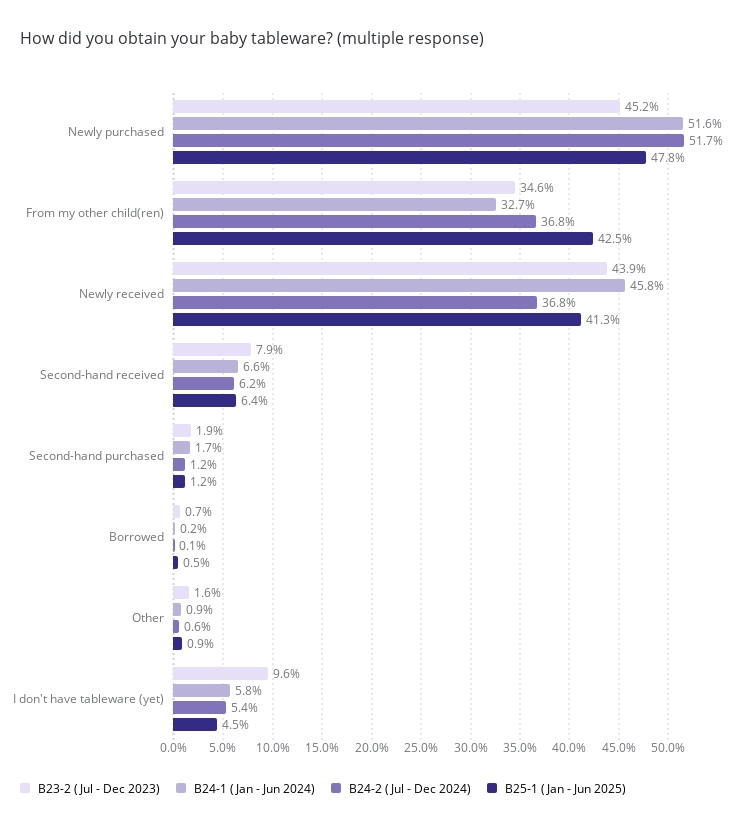
The preference for new is also clear for children’s tableware. About half of the parents buy new tableware. The second-hand market is small: 1.2% buy tableware second-hand, and 6.4% receive it from others. Within the family, tableware is more often reused (42.5%).
What’s in the kitchen cupboard?
Once the baby starts solids, parents mainly buy bibs (76.5%), feeding spoons (71.8%) and drinking cups (58.6%). The 360-degree cup (52.9%) and the sippy cup (35.1%) are particularly popular, because they’re easy to use and help babies learn to drink independently.
On average, parents spend €39 on tableware and €53 on bottles. The fact that parents spend more on bottles may be because tableware is often given as a gift (41.3%), meaning they have to buy less themselves.
Trusted brands
For feeding bottles, Dr. Brown’s remains the market leader at 50.3%, followed by Philips Avent (35.1%) and Difrax (32.4%). These brands have held the top three spots for years. For drinking cups, Munchkin is the clear favourite (38.6%), but Philips Avent and Difrax also feature in the top five. So parents choose not only convenience, but also brands they trust.
Baby products you want to feel first
Although online shopping is increasingly the norm, baby bottles and children’s tableware are notable exceptions. One in four parents buy these products exclusively through an online store (28.6% for bottles, 25.8% for tableware). The rest always make at least one purchase in a physical store. Perhaps these parents want to hold, compare, or feel these items first. Or perhaps these are the kinds of products you pick up when you happen to see them on the shelf. Whatever the reason, the picture has been stable for years: online shopping is popular, but not for everything.
‘Parents therefore choose not only convenience, but also brands they trust’
About WIJ Monitor
The WIJ Monitor is a continuous study carried out by data-driven media company WIJ Special Media. The study has been running since 2012 and maps the customer journey of (expectant) mothers as they purchase various baby products. WIJ Special Media has extensive knowledge of the baby market and regularly conducts a range of studies. For more information contact researcher Marloes Wilms at marloes.wilms@wij.nl.
Want to know more about the WIJ Monitor?
We’d be happy to share all the ins and outs of this ongoing study with you.
Also interesting
WIJ Monitor research: Babywereld September 2025
WIJ Monitor survey: Babywereld, June 2025